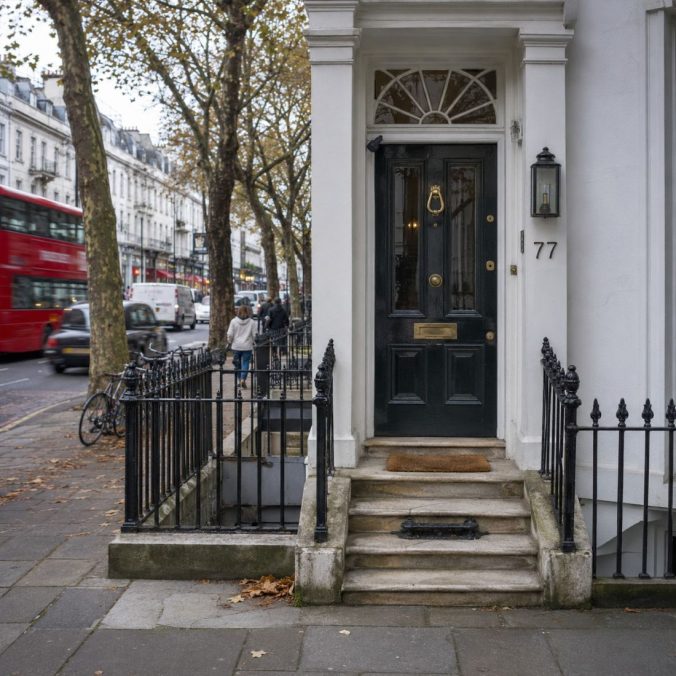
The front door on a main road gets dirty in a way that the same door two streets back never does, and it gets dirty from a different set of ingredients. A door on a quiet residential turning collects dust and rain marks. A door on Holloway Road collects combustion products, and combustion products are sticky.
That difference decides the whole method. Wipe a greasy film with a dry cloth and you smear it. Wipe it with the wrong chemical and you take the sheen off the paint. I have watched people spend an hour on a door and leave it looking worse in flat daylight than when they started.
What is landing on your front door?
Four main things, and none of them are what most people picture.
Diesel particulate is the first, a fine black carbon that carries an oily fraction, which is why it bonds rather than settles. Brake dust is the second – iron particles thrown off pads at every set of lights, which is why houses near a junction or a pedestrian crossing suffer more than houses mid-block. On Streatham High Road, the properties either side of the crossing lights are visibly worse off than the ones fifty metres up.
Tyre rubber makes the third, a fine dark powder that shows most on white or cream paintwork. And then there is the general urban load: brick dust, pollen in May, and cooking extract if there is a takeaway within three doors.
Mixed together and bound by the oily element, they form what the car trade calls traffic film – a grey-brown layer that is thin, even, and firmly attached. It is the evenness that fools people. Because it covers the door uniformly, there is no obvious dirty patch, so the door reads as merely tired rather than dirty. Wash one panel and stop, and the difference is startling.
Why the film goes greasy rather than dusty
Dry dust falls off in rain. Traffic film does not, because the hydrocarbon content makes it water-repellent, which is why a door that has stood through a week of February rain on Uxbridge Road is no cleaner at the end of it.
The practical upshot: you need a surfactant. Plain water will not lift it, whatever the label on your cloth says. Warm water with a degreasing detergent in it, worked with a soft cloth, is the entire secret and there is no clever product that beats it.
How often does a street-facing entrance need doing?
Monthly for a main road, quarterly for a side street, and there is a real reason for the gap rather than a made-up one.
Traffic film builds in layers and each layer is easier to remove within about four to six weeks. Past that, the oily fraction oxidises and the layer beneath it starts to key into the paint surface, particularly on older gloss where the finish has gone slightly chalky with UV. Two years of unwashed film on a south-facing door in Shepherd’s Bush will not come off with detergent at all – you are into solvent work, or repainting.
So the monthly wash is cheap insurance on a paint job worth several hundred pounds. Fifteen minutes with a bucket, as it goes, and the door outlives the neighbours’ by a decade.
Winter changes the job
Road salt is the winter complication and it lands higher than people expect – spray off passing traffic reaches the bottom third of a door on a road with a 30mph limit, and considerably higher if the pavement is narrow. Salt attacks the bottom rail of a timber door, which is the part most likely to have a hairline crack in the paint, and once salt water is behind the paint film it lifts it.
From November to March, do the bottom eighteen inches of the door and the threshold weekly if you can be bothered. Plain warm water is fine for this – you are diluting and removing salt, not degreasing.
What is the right method for the door itself?
Depends entirely on what the door is made of, and the mistake I see most often is the uPVC method applied to painted timber.
For painted timber, gloss or eggshell: warm water, a squirt of washing-up liquid or a dedicated traffic film remover diluted well past the recommended strength, and a soft microfibre. Work top to bottom in overlapping passes. Rinse with clean water immediately – detergent left to dry on gloss leaves a bloom. Dry with a second cloth rather than leaving it to air, because London water spots.
For uPVC, the same wash, then a resin-based uPVC restorer on the frame if it has gone chalky. Yellowing on white uPVC on a sun-exposed elevation is oxidation, and cleaning does nothing for it. There are cream restorers that work reasonably and a lot that do not.
Composite doors need care. The surface is a printed foil or a moulded skin, and abrasive pads take the grain texture off in patches you cannot repair. Soft cloth only, no cream cleaner, no magic eraser. A melamine sponge on a composite door is a permanent dull spot.
Glass panels last, after the frame, so you are not chasing drips.
Door furniture is its own job
Unlacquered brass on a Georgian door wants a metal polish and a soft cloth, and it will need doing every three or four weeks on a busy road because sulphur compounds in traffic exhaust tarnish brass fast. Lacquered brass wants nothing but soapy water – polish strips the lacquer and then you have committed yourself to polishing it forever, which is a decision people make by accident all the time.
Chrome and satin nickel: soapy water and a dry buff. Antique iron: a wipe and an occasional oil, never a wax that will come off on hands.
The letterplate is the filthiest single component on any London front door. The inside face of the flap collects everything, and nobody has ever cleaned it. Open it, wipe both faces, do the hinge.
How do you handle the step, path and threshold?
Carefully, if the step is anything older than about 1960.
Victorian and Edwardian entrances across most of inner London have encaustic tiled paths – the geometric red and buff tiles you see in Camberwell and along half the terraces in Leytonstone. They are unglazed, they are porous, and they are worth restoring rather than replacing at anything from £200 a square metre. They also break easily, and the grout between them is soft lime mortar in the original installations.
Warm water, a stiff brush that is not wire, and a pH-neutral tile cleaner. Acidic cleaners eat the mortar. Bleach lightens the buff tiles unevenly and the patchiness never quite goes.
York stone and limestone steps: same principle, neutral cleaner, no acid. Concrete steps you can be rougher with.
Algae and the green film that grows on a north-facing step want a proprietary biocidal wash left to dwell rather than scrubbing, because scrubbing removes the visible growth and leaves the spores.
The pressure washer question
Do not, on any period entrance. This is where I lose arguments with clients and I have not changed my position in years.
A pressure washer on Victorian path tiles blows out lime mortar joints, drives water under the tiles, and lifts the surface off any tile that has already started to spall. On stone it opens the surface and makes it dirty faster afterwards. On painted timber it forces water behind the paint film. I have seen a beautiful tiled path off a road in Tooting turned into a jigsaw by a hired machine and a confident afternoon.
Modern concrete or block paving, fine, go ahead. Anything else, a brush and a bucket, as it goes.
What ruins an entrance faster than the traffic does?
The cleaning, most of the time.
The list of things I have been called out to repair: a bleached patch on a York stone step where somebody poured neat thin bleach to kill algae; a composite door with a dull rectangle from a melamine sponge; a brass knocker in Woolwich stripped of lacquer with Brasso and left to go green within a fortnight; scoured gloss paint where a scouring pad went at a stubborn mark. Each of those was a fifteen-minute job that turned into a repaint or a replacement.
The porch and the bit nobody looks up at
Recessed entrances collect what the street throws and then hold onto it, because there is no rain reaching the back corners to wash anything through. Cobwebs in the head of the arch, a drift of leaf litter and cigarette ends in the corner behind the door, and on any porch within reach of a parapet or a ledge, pigeon mess that has been there long enough to bleach the stone underneath it.
Do the ceiling of the porch first with a soft broom, then the walls, then the floor, and expect to do the floor twice. Pigeon droppings want softening with warm water and lifting rather than scraping, and gloves on for that one, as it goes – dried droppings are a real respiratory risk when they turn to dust.
Communal entrances to converted flats are worse again, because responsibility is diffuse and the managing agent’s contractor does the hallway and stops at the threshold.
Rule of thumb worth holding: use the mildest thing that works, and give it dwell time instead of pressure. Rinse everything afterwards.
And the part that costs me money to say – a street-facing front door on a monthly cycle is a homeowner job, not a contractor job. Fifteen minutes, a bucket of warm soapy water, two cloths. Paying somebody to come out for that alone is poor value, and if a firm quotes you for a monthly door wash they are selling you a call-out charge. Book the professionals for the path restoration and the render or brickwork above the door – the jobs with machinery and consequences behind them.
My own front door faces a bus stop. I do it on the first Sunday of the month with the same red bucket, and the letterplate flap still gets forgotten about half the time.