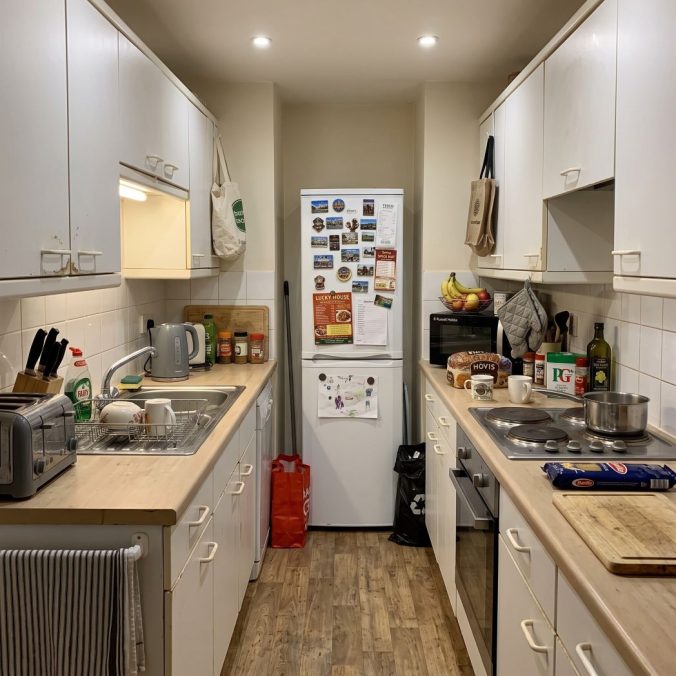
Two metres wide, four metres long, units down each side, no opening to the outside world. That describes an enormous number of London kitchens – internal kitchens in purpose-built blocks from the sixties, the ones carved out of a rear reception room in a Victorian conversion, and a good share of the new-builds around Stratford where the kitchen sits mid-plan and the living space takes the daylight.
These rooms fail differently from kitchens with windows. Understanding how they fail is most of the battle, because the standard advice about wiping down after cooking was written for a room where the air changes on its own.
What makes a windowless galley different from any other kitchen?
Nothing leaves. That is the entire distinction.
Cooking throws grease into the air as an aerosol – fine droplets carried on hot, rising, moisture-laden air. In a kitchen with a window over the sink, a decent fraction of that plume goes out through the opening while the rest disperses through the flat. In a sealed galley two metres wide, the plume hits the ceiling, spreads sideways along it, cools, and comes down on every surface in the room, including the ones you would swear never get dirty.
The narrowness makes it worse. A galley concentrates the plume in a small volume, so the deposition per square metre of ceiling is several times what an open-plan kitchen of the same output would see. Cook a fry-up in a windowless galley in Kilburn and you are spraying the whole room with a thin coat of oil.
Then it sits there, and it changes. Fresh grease wipes off with warm soapy water. Grease that has been on a ceiling for eight months has oxidised and polymerised into a hard yellow varnish, and at that point you are into strong alkaline degreasers, dwell time, and a lot of ladder work.
The torch test
You cannot see any of this by eye, because there is no raking daylight in the room to reveal it – just an overhead LED throwing light straight down, which is the worst possible angle for spotting a film.
Take a torch or a phone light, stand at one end, and shine it along the ceiling almost parallel to the surface. In a kitchen that has not been degreased in a year, the light picks up a dull, slightly tacky sheen with tide-lines running out from above the hob. Do the same along the wall units and along the top of the door architrave.
Everyone I have shown that trick to has gone quiet for a second. No two ways about it, it is the most convincing thing you can do in a kitchen.
Where does the grease end up?
Higher and further away than the mess suggests.
The hob splashback gets the visible spatter, and people clean it because they can see it. The real deposition happens on the ceiling above and behind the hob, on the underside of the wall cupboards, on the top surfaces of the wall cupboards where nobody looks, and on the extractor housing itself. Then it travels: the doorframe at the far end of a galley in a Thornton Heath flat will carry a grease film even though it is three metres from the hob, because the plume runs along the ceiling until it meets the wall and turns.
Textiles catch it too. A tea towel on a rail absorbs airborne grease and holds smell, and so does anything wooden and unsealed.
Light fittings are the ones I want people to check. A flush ceiling light in a windowless galley collects grease on the diffuser and on the bulb behind it – and warm grease on a warm bulb smells, which is a large part of why some kitchens have a background odour nobody can locate.
Inside the cupboards
Grease gets into closed cupboards through the gap round the door and the vent holes in the base of the carcass. Not much, but over three or four years it builds a tacky film on the inside of the door and along the front edge of the shelves, which then collects dust and goes brown.
The tops of the wall cupboards, if they are not boxed in to the ceiling, are the worst square metre in any London kitchen. Grease and dust together, in a room with no air moving through it, set into something closer to glue than dirt. Twice a year with a strong degreaser and a scraper, or line them with baking parchment and change the parchment instead.
What order should you clean a galley in?
Top to bottom, far end to near end, and in one pass, because a galley punishes backtracking more than any other room shape.
There is no staging space in a two-metre-wide kitchen. Everything you take off a worktop has to go somewhere, and the somewhere is usually the floor of the corridor outside or a chair dragged in from the living room. So clear completely before you start rather than shuffling items around the room, which is what most people do and which doubles the time.
Ceiling first with a flat-head mop and a degreaser solution. Wall units and their undersides second. Splashback and hob third. Worktops fourth. Sink and taps fifth. Floor last, and in a galley the floor takes a hammering along a strip about half a metre wide down the middle where every footstep in the flat’s cooking life has landed.
Extractor at whatever point suits you, so long as it is before the worktops, because filter cleaning drips.
Working in a two-metre-wide room
Use a bucket rather than a spray bottle for the ceiling and walls, because a spray in a confined windowless room puts degreaser into the air you are breathing for the next twenty minutes. Ventilate what you can – prop the flat’s front door, open a window in the next room, and put a fan in the doorway pointing out.
Wear gloves. Alkaline degreasers at working strength will strip the oil out of your hands in half an hour, and the ones sold for commercial kitchen use are considerably stronger than the supermarket versions.
What should you do about the extractor?
Start by finding out which kind you have, because it changes everything and about half the people I ask do not know.
A ducted hood pushes air out through a wall or a riser. A recirculating hood pulls air through a grease filter and a charcoal filter and blows it straight back into the room. In a windowless galley it is almost always recirculating, because there is no external wall to duct through.
Here is the unpopular part. A recirculating hood does very little about grease and nothing whatsoever about moisture. It catches some of the heavy droplets in the metal mesh, then returns warm, damp, partly-greasy air to the room it came from. Treat it as a light fitting that reduces smell slightly when the charcoal is fresh, and do not credit it with keeping your kitchen clean, because it is not doing that.
Which is why the ceiling in a recirculating-hood kitchen needs degreasing twice a year and the one in a ducted kitchen does not.
The filters
Metal mesh grease filters go in the dishwasher, or in the sink with very hot water and a scoop of soda crystals for twenty minutes. Monthly, and in a windowless galley monthly is a floor – a saturated mesh drips grease back onto the hob, which people notice as mysterious brown spots on the splashback.
Charcoal filters do not wash. They saturate and stop adsorbing anything, at which point the hood is a noisy fan. Three to six months is the honest interval, they cost £10 to £20 a pair, and I would guess four out of five recirculating hoods in London flats have never had theirs changed since installation.
How do you keep smell and damp under control with no air?
Deal with the moisture at source and the smell mostly handles itself.
Lids on pans. That one change removes more water vapour from a windowless kitchen than any appliance, no two ways about it – a rolling pan of pasta uncovered puts something like half a litre of water into the air over the cooking time, and in a sealed galley that water condenses on the coldest surface in the room and feeds mould in the corner behind the fridge.
Run the hood before you start cooking and for fifteen minutes after, and keep a window open elsewhere in the flat, because a galley with the door shut is a box. Wipe the hob and the splashback while they are still warm, which takes thirty seconds and saves the fortnightly scrub.
Smells that are not coming from the cooking
A windowless galley holds three or four odour sources that have nothing to do with what is on the hob. The washing machine door seal, which stays shut and damp between washes and grows a black rim inside the fold – pull the fold back and check it, because that is the one people never find. The dishwasher filter in the base of the machine. The underside of the bin lid, and the floor beneath the bin where liquid finds its way out of bags.
And the U-bend under the sink in a kitchen that gets used lightly. A flat in Kew where the owner ate out most nights had a faint drain smell for a year because the trap was drying out between uses, no two ways about it. Run the tap for thirty seconds a day and it goes.
And the thing I would tell you even though it argues against my own invoice: if you have a windowless galley, twenty minutes a week with hot water and washing-up liquid on the ceiling above the hob and the hood housing will keep the room out of deep-clean territory for years. Two of those a year at contractor rates costs more than a decade of your own Sunday mornings, and the only reason most people end up booking one is that nobody ever told them the ceiling was part of the kitchen.
Last galley I degreased was in a Clerkenwell conversion, no window, ducted hood that had been disconnected during a refurbishment in about 2015 and left blowing into a void. Ceiling came up white after two passes. The void, I did not open.